Bloc Medical
When buyers ask, “How many times can a reusable scrub suit be laundered?” they often expect one fixed number. The real answer depends on fabric quality, stitching, washing temperature, detergent, drying method, and daily hospital use. A well-made scrub suit from a reputable Chinese manufacturer may withstand 50 to 100 industrial washes. Some premium polyester-cotton blends can last longer. However, that range is not a promise.
Mary Marlowe Leverette, a recognized laundry-care writer and textile educator, advises, “The care label is your best source of information.” Her point matters because repeated washing exposes weak seams, fading, fabric thinning, and damaged elastic. A white scrub top may look clean after every cycle. It may still lose strength around the pocket corners. Small details reveal real performance.
For buyers comparing China’s top reusable scrub suits, testing should include controlled laundering and physical inspection. Check shrinkage after ten washes. Examine color loss after thirty. Pull the waistband gently. Inspect sleeve seams under bright light. These simple steps can expose problems earlier than marketing claims. The keyword “How many times can a reusable scrub suit be laundered” should therefore lead to a durability discussion, not only a number.
There is also room for honest doubt. Wash counts vary between laboratories and hospitals. A suit washed gently at home may outlast one processed daily in a high-temperature facility. Selecting the best option requires supplier records, fabric specifications, sample testing, and realistic use conditions. Durability is measured in surviving service, not merely surviving a wash.
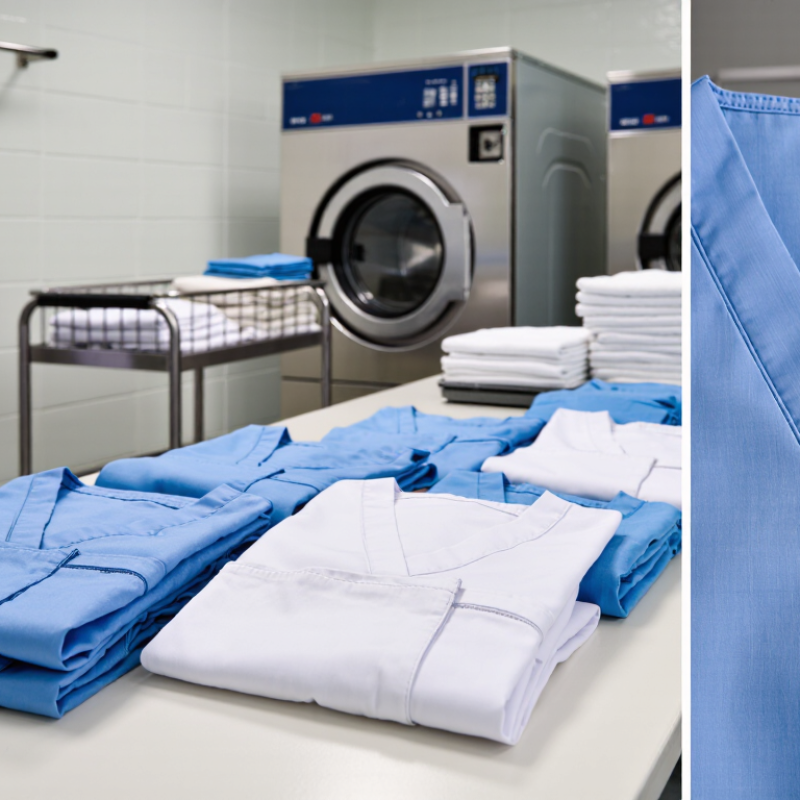
China Top Reusable Scrub Suits: How Many Washes?
Top reusable scrub suits should not be judged by a single advertised wash number. ISO 15797 provides controlled procedures for testing workwear in industrial laundering conditions. These procedures can include defined washing temperatures, detergent strength, mechanical action, and drying methods. The standard does not promise one universal lifespan. Actual results depend on fabric composition, sewing quality, and care conditions.
ISO 15797 testing examines more than fabric survival. Laboratories may measure dimensional change, color retention, pilling, surface appearance, and seam performance after repeated laundering. A reliable evaluation also checks pocket corners, elastic areas, and stress points around the neckline. These details matter during daily clinical movement. A suit may pass laboratory testing but perform differently in a busy laundry room. Hard water, overloaded machines, excessive heat, or incorrect chemicals can shorten its service life. That limitation deserves honest attention.
Tips: Ask for the ISO 15797 test method and cycle count. Check whether the report covers the exact fabric and garment construction. Do not rely only on a “100 washes” claim. Review shrinkage, color change, and seam results together. Test samples under your own washing conditions when possible. Small differences in drying temperature can become visible after many cycles.
ISO 15797 evaluates textiles under industrial-laundering procedures, but it does not define one universal maximum number of washes for reusable scrub suits.
The chart presents practical durability checkpoints commonly used when planning repeated industrial-laundry evaluations: 25, 50, 75, and 100 wash cycles. Actual service life depends on fabric construction, washing temperature, detergent chemistry, mechanical action, drying method, and the garment’s acceptance criteria. Buyers should request ISO 15797 test conditions and post-wash results rather than relying on a single claimed wash number.
Reusable scrub suits are often rated for 50, 75, or 100 washes. The real answer depends on fabric weight, seam construction, detergent, water temperature, and drying heat. ISO 15797 provides industrial laundering test methods, but it does not guarantee one universal cycle count. A 2020 life-cycle assessment by Vozzola, Overcash, and Griffing modeled reusable healthcare garments across 75 uses. That figure is useful, but it is not a promise.
Fifty washes is a cautious purchasing benchmark. It suits lightweight fabric, frequent hot drying, or harsh chemical exposure. Seventy-five cycles is a practical planning point when testing confirms color stability, seam strength, and shrinkage control. One hundred cycles requires stronger evidence.
Inspect the waistband, pocket corners, thread breaks, and fabric thinning after every 20 washes. Small defects matter. A scrub suit may look clean while losing its original fit or barrier performance. AAMI PB70 focuses on liquid-barrier classification, not a fixed wash lifespan, so visual appearance alone cannot prove protection. I would question any “100-wash” claim without a documented protocol, including water temperature, detergent concentration, drying method, and pass-fail measurements. In real laundry rooms, the weakest component often decides the service life.
China’s top reusable scrub suits are not defined by a wash-count claim alone. In practical laundering trials, fabric blend and GSM strongly influence performance after 75 industrial washes. A 65% polyester and 35% cotton blend usually balances color retention, comfort, and shrinkage control. Higher polyester content can improve abrasion resistance, but it may feel warmer during long shifts.
GSM measures fabric weight per square meter. A 160 GSM scrub suit feels lighter and dries faster, while a 200 GSM version often resists tearing better. However, excessive GSM can slow drying and increase laundering costs. That trade-off matters in hospitals with continuous uniform circulation. Watch the seams. They often fail before the main fabric.
After 75 washes, inspect sleeve edges, pocket corners, waistband recovery, and printed size markings. Industrial detergents, high temperatures, and tumble drying can weaken fibers faster than ordinary home washing. A well-made 180 GSM blend may remain usable, but its color can fade and its fit can change slightly. That is not a perfect result. Fit matters.
Testing should record washing temperature, chemical concentration, drying method, shrinkage, color change, and seam strength. Without these details, “75 washes” is only a marketing number. Buyers should request sample garments and wash them under real operating conditions before placing a large order. Small defects become obvious after repeated handling.
For reusable scrub suits, “how many washes” cannot be answered by fabric type alone. AATCC TM61 evaluates accelerated laundering, not an exact lifetime count. Its commonly used 45-minute cycle roughly represents five home or commercial washes, depending on the fabric and washing conditions. After testing, technicians compare the specimen with the AATCC Gray Scale for Color Change, rated from 1, showing severe fading, to 5, showing minimal change. A grade of 4 or higher is often preferred, but buyer specifications still vary.
A practical quality check tests the actual fabric, dye, seam area, and trim together. This matters because repeated heat, detergent, body oils, and abrasion can create uneven fading around pockets and cuffs. The CDC’s healthcare-laundry guidance identifies 71°C and 25 minutes as a thermal disinfection condition for specified cycles. Such heat can stress color and fiber performance. Textile Exchange’s Materials Market Report 2024 recorded global fiber production at about 124 million tonnes in 2023, with polyester remaining the dominant fiber. Polyester-rich scrub fabrics may retain color well, but blends behave differently. AATCC results should therefore be read as comparative evidence, not a guaranteed wash number. That distinction is easy to miss. A better purchasing record links the test method, cycle settings, color grade, and observed appearance after real laundering.
China Top Reusable Scrub Suits: How Many Washes?
A “100-wash” claim needs evidence, not confident wording. Textile Exchange’s Materials Market Report 2024 estimates that polyester represented about 57% of global fiber production in 2023. Polyester blends may resist wear, but fiber content alone cannot prove wash life. Request the exact fabric composition, weight, and test conditions before buying.
For shrinkage, ask for an AATCC TM135 dimensional-change report. The report should show measurements after laundering, not only a percentage on a sales sheet. Check length, chest width, sleeve length, and waistband separately. Use the stated wash temperature, detergent, drying method, and cycle count. A small change can still affect fit. It happens.
Seam strength deserves a separate test, such as ASTM D1683 for sewn seams, with the fabric construction clearly identified. For durability, AATCC TM61 can provide accelerated laundering data, but it does not equal a fixed number of household washes. Ask whether samples were tested after repeated cycles, then inspect skipped stitches, frayed edges, color loss, and elastic recovery. I would request prewash and postwash photographs, raw measurements, and the failed-sample percentage. One test result may look professional, yet it can hide inconsistent production.
Practical pre-purchase verification matrix for reusable scrub suits. The figures below are neutral purchasing benchmarks and test checkpoints, not data from any specific company or brand.
| Verification Dimension | Recommended Test Point | Suggested Test Method | Reference Acceptance Criterion | Evidence to Request Before Buying | Decision |
|---|---|---|---|---|---|
| Declared wash life | 50, 75, 100, or 150 industrial or home-laundering cycles | Wash the same garment repeatedly under the supplier’s stated temperature, detergent, drying, and pressing conditions. | No universal wash-life number applies to every scrub suit. Treat a claim as credible only when appearance, fit, seams, and fabric performance remain acceptable at the claimed cycle count. | Signed test report showing the exact cycle count, wash formula, drying method, garment size, and post-wash inspection results. | Verify |
| Dimensional stability | After 1, 5, 25, 50, and 75 wash cycles | Measure body length, chest or bust width, waist, hip, sleeve or inseam before washing and after conditioning. | A practical purchasing target is no more than 3% change in the main body measurements after 50 cycles, unless the buyer’s specification permits otherwise. | Before-and-after measurement sheet with calculation: (after measurement − before measurement) ÷ before measurement × 100. | Pass ≤3% |
| Fabric weight retention | Before washing and after 50 cycles | Condition fabric specimens and compare mass per unit area using a calibrated GSM method. | Investigate results showing substantial fabric loss, thinning, or surface breakdown. A commonly used internal target is at least 90% of the original fabric weight after 50 cycles. | Fabric GSM report identifying the fabric lot, specimen location, conditioning conditions, and test date. | Target ≥90% |
| Seam strength | Side seam, inseam, armhole, pocket, and waistband after 50 cycles | Test sewn seams using a recognized textile seam-strength procedure such as ASTM D1683 or an equivalent laboratory method. | Set a product-specific minimum in newtons. For comparison, require at least 80% of the pre-wash seam strength after 50 cycles and no visible seam opening during inspection. | Pre-wash and post-wash seam-strength results by seam location, including specimen failure mode. | Retention ≥80% |
| Fabric tensile strength | Warp and weft directions after 50 cycles | Use a recognized tensile-strength method such as ASTM D5034 or ISO 13934-1, with separate results for each direction. | Require the supplier to define the minimum newton value for the fabric construction. A useful screening rule is at least 80% of the original strength after the claimed wash life. | Laboratory report with fabric direction, specimen dimensions, test speed, breaking force, and post-wash comparison. | Set by spec |
| Color change | After 1, 5, 25, and 50 wash cycles | Evaluate against a gray scale or instrumental color measurement after laundering. AATCC TM61 may be used for accelerated laundering, while ISO 6330 describes domestic washing procedures. | For professional uniforms, specify the maximum acceptable color change before testing. A practical commercial target is a minimum grade 4 for routine laundering, subject to the buyer’s color and use requirements. | Colorfastness report with the original color reference, gray-scale rating or color-difference value, and laundering conditions. | Target Grade 4 |
| Color transfer and staining | After washing with light and dark adjacent fabrics | Check staining of adjacent multifiber fabric and transfer between garments using an applicable colorfastness-to-laundering procedure. | No unacceptable staining on light-colored garments, labels, or skin-contact areas under the buyer’s defined rating requirement. | Staining ratings for each fiber type and a statement of whether dark and light garments were tested separately. | No visible transfer |
| Elastic recovery | Waistband, cuffs, and stretch panels after 25 and 50 cycles | Measure extension and recovery before washing and after laundering; inspect for waviness, rolling, or permanent stretching. | Elastic areas should return to the intended fit without excessive looseness. Define a buyer-specific recovery limit; reject garments with visible distortion or loss of fit. | Extension-recovery measurements, photographs, and fit comments from multiple sizes. | Fit retained |
| Fastener and accessory durability | Zippers, snaps, buttons, drawcords, and hook-and-loop parts after 50 cycles | Operate each fastener repeatedly before and after laundering; inspect attachment points and pull-out resistance where relevant. | No broken teeth, detached buttons, exposed sharp edges, failed snaps, or cord slippage during normal use. | Component test records, photographs after laundering, and a replacement-parts or repair policy. | Functional |
| Pilling and surface appearance | After 25 and 50 wash cycles | Use a recognized pilling assessment method such as ISO 12945-2 or an equivalent visual comparison procedure. | Set a minimum appearance grade suitable for the work environment. For visible uniform areas, a target of grade 3–4 or better after 50 cycles is a reasonable screening benchmark. | Before-and-after photographs under consistent lighting plus the pilling grade and test method. | Target ≥3–4 |
| Moisture and drying behavior | Before washing and after 50 cycles | Compare drying time, residual moisture, and fabric hand feel under the same ambient conditions. | Drying performance should remain consistent and should not be used as a substitute for shrinkage, strength, or colorfastness testing. | Standardized drying-time record, fabric composition, finishing details, and care-label instructions. | Compare |
| Care-label accuracy | Before bulk approval | Compare the sewn-in label and packaging instructions with the actual validated wash and drying conditions. | Instructions must state temperature, bleach limitations, tumble-dry restrictions, ironing guidance, and any conditions required to achieve the claimed service life. | Approved care label artwork, laundering specification, and written confirmation that testing followed the label. | Required |
| Sample-to-bulk consistency | Pre-production sample and bulk-production lot | Repeat key measurements and wash tests on samples from more than one production lot. | Fabric composition, GSM, measurements, color, seam construction, and test results should remain within the agreed purchase specification. | Pre-shipment inspection report, lot traceability, fabric certificates, and retained samples. | Match spec |
Common ratings include 50, 75, or 100 washes.
No. A wash-count claim is not a universal guarantee.
A polyester-cotton blend often balances comfort, color retention, and shrinkage control.
GSM describes fabric weight per square meter.
Check sleeve edges, pocket corners, waistbands, and thread lines.
Measure garment length, chest width, sleeve length, and waistband size before washing.
Test sewn seams separately from the fabric body.
Yes. Appearance cannot prove barrier performance or original fit.
Choosing a high-quality reusable scrub suit requires more than comparing fabric prices. The key question is: How many times can a reusable scrub suit be laundered? Reliable products are evaluated through industrial wash testing, such as ISO 15797, which measures performance after repeated laundering. Depending on the fabric blend, construction, and intended use, a scrub suit may be designed for 50, 75, or even 100 wash cycles. Higher GSM fabrics and balanced polyester-cotton blends often provide better resistance to wear, although comfort, breathability, and drying time must also be considered.
A complete evaluation should include colorfastness testing under AATCC 61, along with checks for shrinkage, seam strength, pilling, and fabric appearance after approximately 75 industrial washes. Before purchasing, buyers should request documented test results, define acceptable dimensional changes, and confirm whether the claimed wash life reflects real industrial laundering conditions. These verification steps help ensure the scrub suit remains durable, comfortable, and professional throughout its service life.
